
Installing a Gravel French Drain System to Protect Your Home’s Foundation
March 12, 2026
Soil saturation increases lateral pressure against foundation walls. As groundwater rises within backfill, moisture collects along below grade surfaces and pushes against concrete through small cracks, joints, and porous sections. A gravel French drain system redirects that subsurface water before pressure accumulates. Surface grading alone cannot control groundwater movement when soil density and compaction restrict natural drainage.
How Hydrostatic Pressure Impacts Foundation Walls
Saturated soil applies continuous force across the entire wall surface. Clay-heavy backfill retains moisture and limits drainage, increasing the load transferred to the structure. That pressure contributes to hairline cracking, wall deflection, and interior moisture infiltration when no drainage path exists.
Freeze thaw exposure compounds this stress. Wet soil expands during freezing conditions and presses inward against the wall. Drying periods reduce soil volume and can widen existing cracks. Intercepting groundwater at footing depth reduces repeated expansion cycles along the concrete surface.
The Role of Gravel in Subsurface Drainage
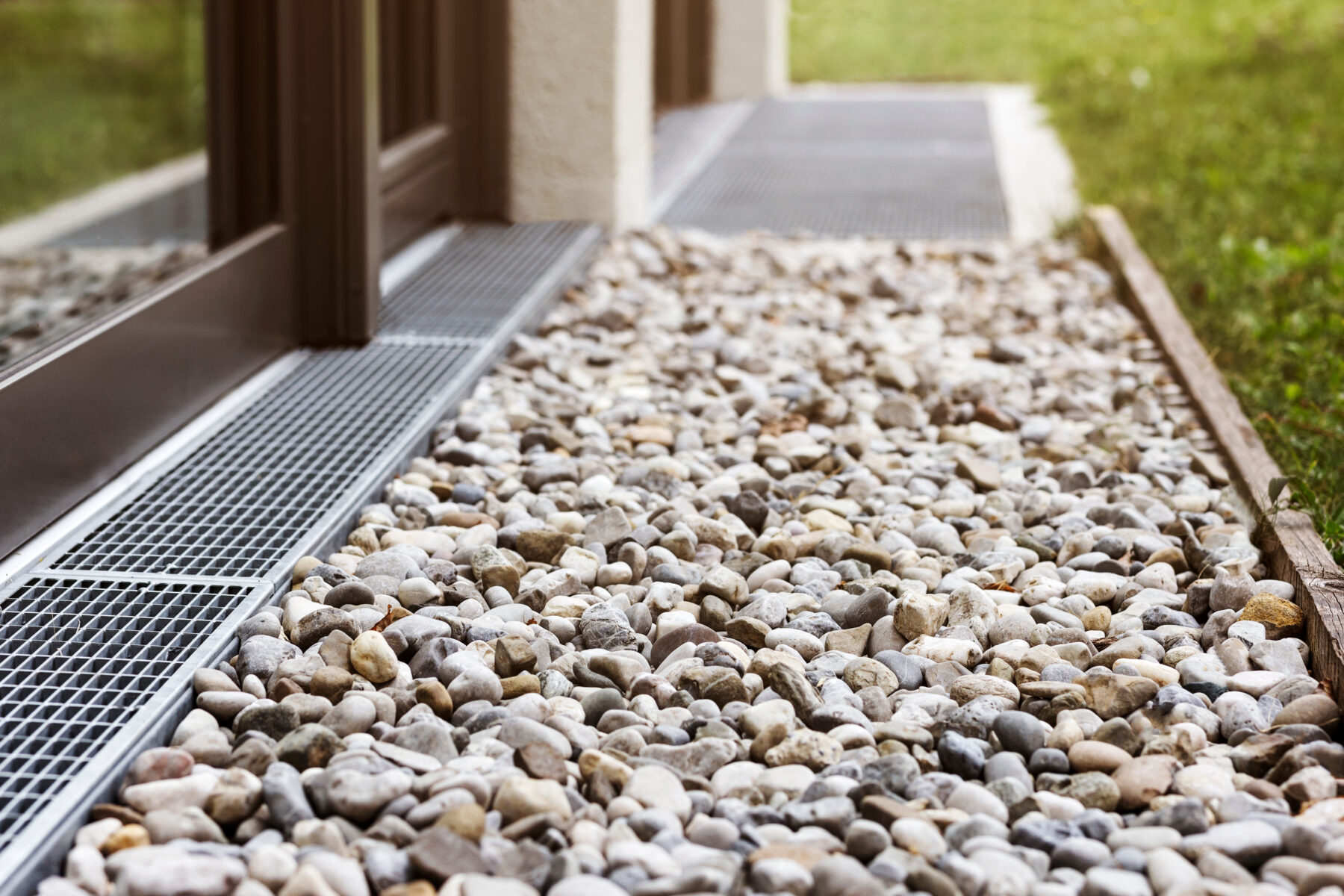
Drainage within a French drain depends on void space between aggregate particles. Clean, angular gravel creates interconnected openings that move groundwater toward a perforated pipe. Material containing fines blocks those openings and restricts water flow within the trench.
Washed gravel between three quarter inch and one and a half inches maintains consistent permeability along the system length. Angular particles interlock under soil load while preserving open pathways for water migration. Uniform aggregate size prevents localized saturation zones inside the trench. Continuous void structure supports steady gravity flow toward the outlet.
Excavation and Trench Configuration
Trench excavation begins at the highest elevation along the foundation and slopes toward a discharge point. A minimum one percent pitch establishes gravity movement within the pipe and prevents standing water inside the system. Without slope, collected water remains in place and transfers pressure back into surrounding soil.
Excavation depth typically extends to the base of the footing to intercept groundwater before it rises along the wall. Trench width commonly ranges from twelve to eighteen inches, allowing adequate space for aggregate placement and pipe alignment. Straight trench lines and consistent depth maintain uniform drainage behavior throughout the run.
Filter fabric lines the trench prior to gravel placement. This barrier separates native soil from the drainage aggregate and limits migration of fines into the void structure. A base layer of washed gravel then forms a stable platform that supports pipe placement and preserves internal drainage channels.
Pipe Installation and Aggregate Backfill
Perforated pipe rests on the gravel base with perforations oriented downward or slightly angled. This positioning captures rising groundwater at the lowest point within the trench. Centered placement maintains even gravel coverage around the pipe and distributes soil load evenly.
Gravel backfill surrounds the pipe and extends several inches above it. Light compaction stabilizes the trench while preserving interconnected void space within the aggregate layer. Maintaining that structure prevents trench saturation during heavy rainfall events and keeps water moving toward discharge. Filter fabric folds over the top of the gravel layer before final soil backfill to reduce intrusion of fines during repeated wet conditions.
Directing Collected Water Away from the Structure
Discharge elevation must remain lower than the trench to maintain continuous gravity flow. Daylight outlets, approved storm connections, or engineered dry wells move collected water beyond the foundation perimeter. Outlet placement too close to the structure allows water to reenter the same soil zone.
Freeze thaw exposure at the discharge point can restrict flow if water collects and freezes. Outlet areas require clear pathways free of debris to maintain unrestricted drainage. Downspout extensions and surface grading should direct roof runoff away from the trench line to reduce total soil saturation around the foundation.
Hydrostatic pressure develops when saturated soil lacks a controlled drainage path. A gravel French drain system creates a defined route for groundwater movement at footing depth. Washed, uniformly graded aggregate maintains internal void space under soil load and supports gravity-driven flow within the trench. Proper slope, pipe alignment, and aggregate selection work together to reduce lateral pressure against foundation walls and stabilize surrounding soil conditions.